Editing made easy
Until now, anyone editing DNA has had to go to great lengths to analyse the results. With a new tool, this can now be done directly in the browser, without the need for installation or data sharing.
07/13/2026 · News · IUF - Leibniz-Institut für umweltmedizinische Forschung · Lebenswissenschaften
Researchers at the IUF – Leibniz Research Institute for Environmental Medicine in Düsseldorf release an open, privacy-preserving platform that genotypes CRISPR, base, and prime editing outcomes — with no installation and without uploading sensitive data. Published in Trends in Biotechnology (Cell Press). The work was conducted together with colleagues from the University Hospital in Düsseldorf, the ETH Zürich and the University Paris Cité.
Genome editing lets scientists rewrite DNA, the instruction manual inside every living cell, with a precision that was unthinkable a generation ago. Technologies such as CRISPR have made this almost routine, and its uses now reach far beyond medicine, from engineering hardier crops and more productive microbes to creating sustainable biomaterials. Yet in every one of these applications, making an edit is only half the job: researchers must read the DNA back to confirm that the intended change, and only that change, was actually made, a step that has remained surprisingly slow and difficult.
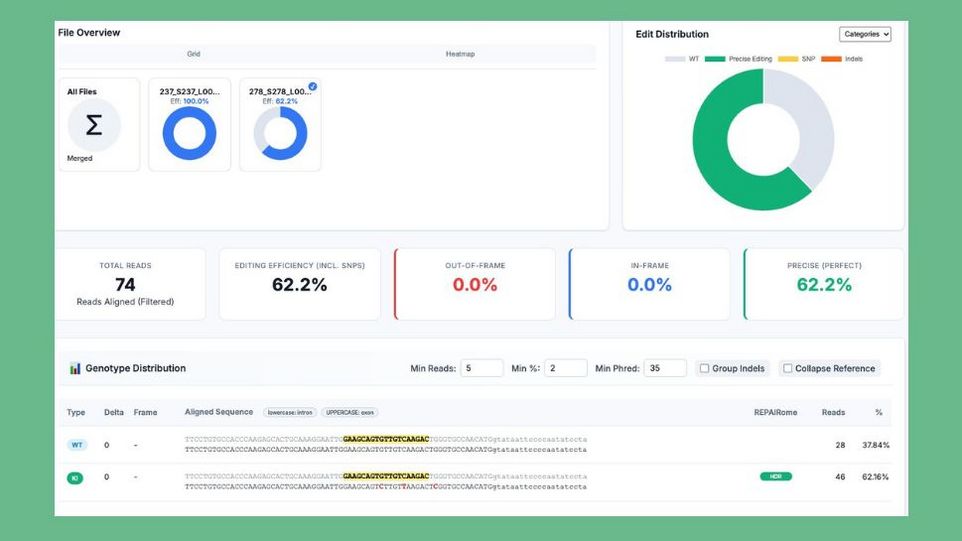
Researchers at the IUF – Leibniz Research Institute for Environmental Medicine have now developed CleanFinder, a freely available, browser-based platform that resolves these editing outcomes quickly and accurately – and without sending sensitive genomic data to external servers. The work is published in the Cell Press journal Trends in Biotechnology.
CleanFinder runs entirely in a standard web browser. There is nothing to install and no programming required, and crucially, no data ever leaves the user’s own computer, which is especially important for patient-derived and clinically sensitive samples. At its core, a specialized “glocal” (combination of global and local) alignment engine classifies the full range of editing outcomes: insertions and deletions, base edits, prime edits, and even mitochondrial DNA editing, across all major sequencing platforms (Illumina, Oxford Nanopore, and PacBio).
Beyond the core analysis, integrated modules extend what a single tool can do: a rapid “Turbo” mode screens entire 96- and 384-well plates at a glance; an allelic-dropout detector flags the hidden loss of one gene copy that can otherwise be mistaken for a clean knockout; a built-in Genome Viewer predicts how an edit changes the resulting protein; and design helpers, including a knock-in donor-oligo designer and sequence-conversion utilities, streamline experiment planning. For large or automated studies, a dependency-free Python command-line version runs the very same analysis engine, enabling reproducible batch processing and seamless integration into bioinformatics pipelines.
The team validated CleanFinder across diverse editing strategies and human-relevant cell models — including CRISPR-Cas9 and Cas12 knockouts and knock-ins, base editing, and complex prime editing in human induced pluripotent stem cells (iPSCs) and blood-forming (hematopoietic) stem cells. For prime editing in particular, CleanFinder cleanly separates the intended precise edits from incomplete or mis-integrated products, a notoriously difficult task — making it well suited to the very cell types at the heart of disease modeling and next-generation cell and gene therapies.
“Genome editing has become routine, but making sense of the data still requires specialist skills, and that holds many labs back,” says Dr. Andrea Rossi, who led the study. “We wanted to remove that barrier. CleanFinder runs in any browser, keeps your data on your own machine, and gives clear, comprehensive answers, so that any lab, anywhere, can analyze its edits with confidence.”
CleanFinder is freely available at https://cleanfinder.org and as open-source code on GitHub. By lowering the technical and privacy barriers to genome-editing analysis, the platform aims to accelerate research from basic disease modeling to the development of new cell and gene therapies.
Publication
Ramachandran H, Dobner J, Nguyen T, Binder S, Tolle I, Vykhlyantseva I, Krutmann J, Miccio A, Staerk C, Brusson M, Kontarakis Z, Prigione A, Rossi A: CleanFinder: A scalable framework for comprehensive genome editing analysis. Trends in Biotechnology 2026. doi: 10.1016/j.tibtech.2026.04.024
Link: https://doi.org/10.1016/j.tibtech.2026.04.024
Further information and contact
Press release – IUF – Leibniz Research Institute for Environmental Medicine (IUF)