Early warning system against viruses
Ten years after Ebola: An international laboratory partnership is strengthening local laboratories in Guinea and improving the early detection of dangerous viruses.
10/28/2026 · News · Bernhard-Nocht-Institut für Tropenmedizin · Lebenswissenschaften · Forschungsergebnis
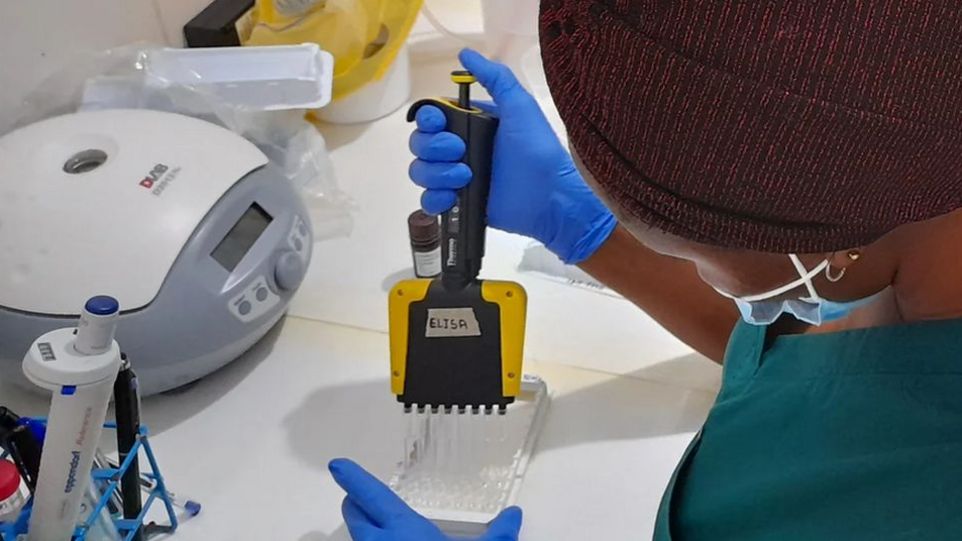
Local laboratory teams in Forest Guinea can test suspected cases of Ebola, Lassa fever and other viral haemorrhagic fevers (VHF) directly on site, with results typically available within a day. Since 2017, the Bernhard Nocht Institute for Tropical Medicine (BNITM) and Guinea’s national VHF reference laboratory in Conakry, the Centre de Recherche en Virologie (CRV-LFHVG), have worked together to build diagnostic capacity in Guéckédou and N’Zérékoré, with support from the Guinean Ministry of Health and the World Health Organization (WHO). Drawing on nearly a decade of surveillance, the researchers document the burden of Lassa fever in the region and explain how sustainable diagnostic structures can support prevention and help reduce the risk of major viral outbreaks. They report their findings in npj Viruses.
The 2014-2016 Ebola epidemic in West Africa brought the need for decentralised, local laboratory capacity to global attention. In response, work began in late 2016 to set up the Laboratory for Viral Haemorrhagic Fevers (LFHV-GKD) in Guéckédou, which has been operating since 2017. In 2021, the laboratory at the regional hospital in N’Zérékoré (LFHV-HRNZE), originally set up during the Ebola outbreak, was also strengthened.
Both laboratories are part of the national VHF surveillance system. They operate under mandate from the Guinean Ministry of Health, with support from the National Reference Laboratory (CRV-LFHVG) in Conakry, the capital. They offer free molecular diagnostics for Ebola, Marburg and Lassa viruses, as well as for yellow fever and dengue viruses.
“Our study highlights the progress made in case detection and epidemiological surveillance in Forest Guinea, underscoring the importance of strengthening our laboratories’ capacity to prepare for and respond to emerging diseases,” says Fara Raymond Koundouno, head of LFHV-GKD, and lead author of the study.
Between 2017 and 2024, the two laboratories tested 4,683 samples from suspected VHF cases, with results available on average within one day. The teams detected Ebola, Marburg and Lassa virus infections, among others. This study shows how a locally anchored laboratory network can operate sustainably and generate reliable data in a high-risk region.
Contributions to Guinea surveillance system for VHFs
For Guinea, this has two main benefits. First, outbreaks can be detected more quickly. The laboratory teams rapidly identified in 2021 the resurgence of Ebola and the emergence of Marburg virus disease, playing a key role in swiftly confirming the cases and initiating countermeasures. Second, diagnostic testing is now generating reliable data on Lassa fever, yellow fever and dengue in a region where the lack of testing had long limited surveillance. Between 2020 and 2024, the laboratories confirmed 30 Lassa fever cases.
"This programme shows what health-system resilience really looks like: diagnostic capacity built to last, not just deployed temporarily during an emergency”, says Dr Sophie Duraffour, head of the “Outbreak Preparedness and Response” laboratory group at BNITM. “The open question is sustainability. Funding for this kind of work is still mostly tied to specific programmes, and shifting that is one of our biggest challenges going forward".
Securing and strategically developing capacities
The authors believe the programme has reached a turning point. In recent years, international funders, above all the Global Health Protection Programme (GHPP) of the German Federal Ministry of Health, have contributed significantly to setting up and running the two laboratories. Sustaining such capacities beyond time-limited, donor-funded programmes, remains a major challenge.
At the same time, the teams see further potential for development: broadening the range of diagnostic tests, integrating peripheral health centres, and developing the laboratories into regional training centres. These centres could train specialists from other prefectures and neighbouring countries, helping to build a cross-border network for outbreak diagnostics.
“Our study shows what sustained support can achieve,” says project leader Dr Giuditta Annibaldis. “If we secure and further develop these capacities, Forest Guinea can move from being an epicentre of major epidemics to becoming a model for community-based disease prevention.”
The authors point out that, at a time when parts of Africa are again facing outbreaks of Ebola disease, currently caused by Bundibugyo virus, sustainable diagnostic capacity in high risk areas is essential. The experience from Forest Guinea shows how decentralised laboratories contribute to national and global health security by enabling earlier case detection, more targeted outbreak control and better data for decision-makers.
Lassa fever in Guinea: long underestimated
Lassa fever is endemic in West Africa, but in Guinea it had rarely been documented. Before the laboratories in Guéckédou and N’Zérékoré were established, there were only a few individual case reports, although earlier seroprevalence studies had suggested that the virus is widespread in some regions. Now, for the first time, systematically confirmed acute cases from Forest Guinea back this up. Between 2020 and 2024, the laboratory teams confirmed 30 cases of Lassa fever, mainly in the prefectures of Guéckédou and N’Zérékoré.
“Our work demonstrates that Lassa virus is circulating in Forest Guinea and highlights the need to continue active surveillance, ideally integrated through a One Health approach, to improve the early detection of cases,” says Youssouf Sidibe, head of LFHV-HRNZE, and lead author of the study.
Around two third of patients with known outcome died (67.9 per cent). The authors conclude that Lassa fever has long been underestimated in Forest Guinea. The low number of cases in the literature was probably due to underdiagnosis and underreporting, as reliable diagnosis and notification were not possible without local laboratory capacity. Recognising Lassa virus infections is the first step towards faster and better care for patients.
“This is a wonderful example of North -South collaboration in sustainable efforts to strengthen health systems, with unprecedented impact on preventing epidemic outbreaks and mitigating their risk”, shares Dr. N’Faly Magassouba, former head of the CRV lab and senior lead author.
Original publication
Fara Raymond Koundouno et al., “Strengthening diagnostic capacity for viral haemorrhagic fevers in Forest Guinea: advances in Lassa fever case detection”, npj Viruses, 2026, doi: 10.1038/s44298-026-00239-9
Further information and contact
Press release – Bernhard Nocht Institute for Tropical Medicine (BNITM)